This report from the ‘Lockhart Review’ (Lockhart, NSW) of March 1927:
A few days previous to his departure for ‘fresh fields and pastures new’ (Lake Cargellico), Mr David MacDonald (so favourably known in the district) was accorded a surprise farewell visit from a number of his friends (mostly Scotch) at his home “Lowan Farm”.
There is ‘na doot’ the fun was fast and furious and full of heartiness, for no man was better respected for his bluff Scotch heartiness than David MacDonald. The same could be said for his daughter-in-law Mrs Ross MacDonald, and other members of his family.
After the usual loyal toast had been honoured, several speakers paid a tribute to the unbounded hospitality and kindly nature of Mr MacDonald, who, well past his seventieth birthday, was one of the best.
Then the bagpipes started to skirl, and ‘O ye gods and little fishes’ the step dancing of the MacWilsons, the MacKenzies and the MacDonalds; the beautiful Scotch* songs of Mr Jack Moffatt, and Mrs Ross MacDonald: the facial contortions of the born comedians, and the wit and repartee of the Lauder troupe all made us think that it is the ‘little touch of nature that makes the whole kin’.
How hard it was to say goodbye to our old friend.
May his shadow never grow less.
( Lowan Farm is now owned by my family. And in the fullness of time will, I gather, be mine.)
*Scotch, Scots, Scottish. I’m quoting.
I can hear a noise that sounds like water dripping somewhere inside. It’s not pleasing. I am very tired now because I can see how long and drawn-out mending things will be here.
I keep thinking of this painting by Bill Hammond:

The (Christchurch) Press (Motto: Nihil utile quod non honestum) has a column called ‘Putting It Right’.
They write: The Press is committed to accuracy and talking with its readers. ‘Putting It Right’ is a forum for clarifications, corrections, trainspotters, pedants, perfectionists, etymologists, polymaths, people who make mistakes and those who never do.
Today’s column includes this entry:
J E Todd points out that On This Day (August 28) was incorrect to say the Scots defeated a British force at Newburn in 1640.
It was an English force. There were no British forces until the 1707 Act of Union.
No, not really.
I am merely trying to clear my head. I don’t want to bore on and on about the earthquake. I’m not sitting in a pile of matchsticks with raw sewage spreading around my feet and a crevasse in the driveway so I am okay. Gerry discovered a crack in the wall (made of Summerhill stone) that I must inspect soon. I know nothing of these things. This is a time when a man about the house can be useful. I might ask my neighbour to look at it. He volunteered to fix my guttering within an hour of meeting me so he’s obviously a ‘good sort’. (I won’t ask).
And the cat came home.

Meanwhile I have a list of domestic matters to attend to, including deciding what cake to make for tomorrow night’s visitors, and finding my copy of H.H. Munro’s ‘The Unbearable Bassington’ for Gerry’s wide reading. Earlier today I watched some videos on youtube on Verdun and thought about sleeping comfortably in one’s bed and reading in the papers the next day that ‘the line still held’. (Verdon–from Verdun–is one of my family names). And I solved a little musical problem about an operatic piece for a stressed colleague as well. It’s raining again. So that’s perfect. I have Talking Heads on, singing ‘same as it ever was’, which may or may not be the case. I simply can’t tell.

G Henderson Julia is home. She is wearing a pair of boots she bought off TradeMe. Her toes end about 5cm before the boots do and she has to get someone to pull them off for her. What a great buy.on Monday · Comment · ·
-
You like this.
-
-
 Jo.Henderson yes but does she look like a stylish equestrienne?23 August at 19:56 ·
 -
 Ju.Henderson yes yes I think she does23 August at 21:44 ·
 -
 GHenderson I think that she just looks like a farmer who can’t afford to buy proper sized boots.Tuesday at 16:42 ·
-
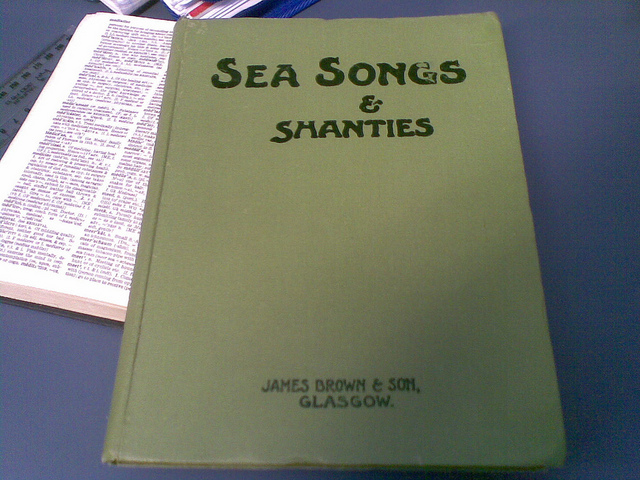
Sea Songs & Shanties, collected by W.B.Whall, Master Mariner
I found this book in the Britten room recently. It was published byJames Brown & Son (Glasgow) Ltd in 1926. The frontispiece is of HMS Victory going into battle at Trafalgar.
Whall writes:
I was intended for the Church, not for the sea, and during my early years at Oxford I received a fairly thorough musical training under the late Sir John Stainer, afterwards organist at St Paul’s Cathedral. Going to sea then, in 1861, in the old passenger-carrying East Indiamen, these Sailor Songs and Shanties struck me as worthy of preservation. During my eleven years in those ships, I took down the words and music of these songs as they were actually sung by sailors, …
Since 1872 I have not heard a Shanty or Song worth the name. Steam spoilt them. A younger generation of seamen took place of the old sea-dog. (In my first year or two at sea, I was shipmates with old men-of-war’s men who had served at sea before 1815, the year of peace, and who were of the old school.) With the new generation, true Sea Songs and Shanties practically disappeared. Echoes of them, it is true, still exist, but that is all. The real thing has gone forever.
I’ve had this book (a great account of Victorian childhood) on my bookshelf for over 20 years without being tempted to read it. However, the name Samuel Butler has kept popping up on a regular basis of late, and, as I like to note signs and portents, I pulled the book from the topshelf of the big bookcase and have started it. I’m up to p. 6 and I really like it so far.
Samuel Butler came to Canterbury, NZ in January 1860 on the Roman Emperor. He travelled into the high country on the far side of the Rangitata River (he described the riverbed as “that torrent pathway of desolation”) and established Mesopotamia and then Erewhon station. Some people might recognise the latter name. Everybody in the English-speaking world should know that’s almost ‘nowhere’ backwards. And yes, it is a book also, one that Butler wrote. It’s on my list.
(Butler was against ‘mental muddle, self-deception and false compromise in society’. He was a Lamarckian and also thought that Homer’s ‘Odyssey’ was written by a woman.)
I heard someone say (or possibly read somewhere) that it was more socially acceptable these days to have syphilis than to admit to being lonely. (That’s debatable).
There is also the very good advice (though somewhat difficult to arrange) that it is best to avoid having syphilitic forebears. People look at me oddly when I say things like that to them. That doesn’t stop me.
St George is the patron saint of syphilis sufferers. Everyone knows who St George is, I know. What they might not know is that my sister was born on St George’s Day (and was married in St George’s in Yenda, NSW). My two younger daughters were born in St Georges Hospital, Christchurch, and my parents-in-law (both deceased) were married on St George’s Day, 1947, which was also Easter Sunday. (None of these people are afflicted with the disease as far as I know).
One of the more interesting theories I have heard on the topic is that put forward by Prof Daellenbach (sp?) at Canterbury University in my German History and Culture course some years (!) ago. He maintains that one of the reasons the Germans didn’t ‘win’ WWI is that they took their troops out of the front line to treat them for syphilis, thus depleting the fighting ranks. Apparently no-one else (especially the French!) bothered with such niceties.

P. Uccello
Similar to macaroons.
Ingredients; 55g butter, 115g sugar, 1/2 t vanilla essence, 1 egg, 2 c coconut (150g)
Preheat oven to 160 degrees C. Line two baking trays with baking paper.
Method: Cream the softened butter and sugar until fluffy, then add the vanilla essence and the egg, and beat well.
Stir in the coconut and mix everything together.
Put in teaspoonsful on the baking tray, flatten slightly with a wet fork.
Bake for about 25 minutes until they are golden.
Cool on racks (leave paper under biscuits). Makes about 48.
From Ladies a Plate: Traditional Home Baking by Alexa Johnston.
 gryphonelle